Computational pathology
HAPPY
HAPPY measures the cellular composition and spatial organisation of placental histology. Its biologically inspired pipeline links tissue measurements with pathology and clinical outcomes.
DPhil researcher · University of Oxford
I develop computational methods for objective, reproducible analysis of the placenta and its pathology.


Big Data Institute · EPSRC Health Data Science CDT
Jesus College · University of Oxford
Oxford, United Kingdom
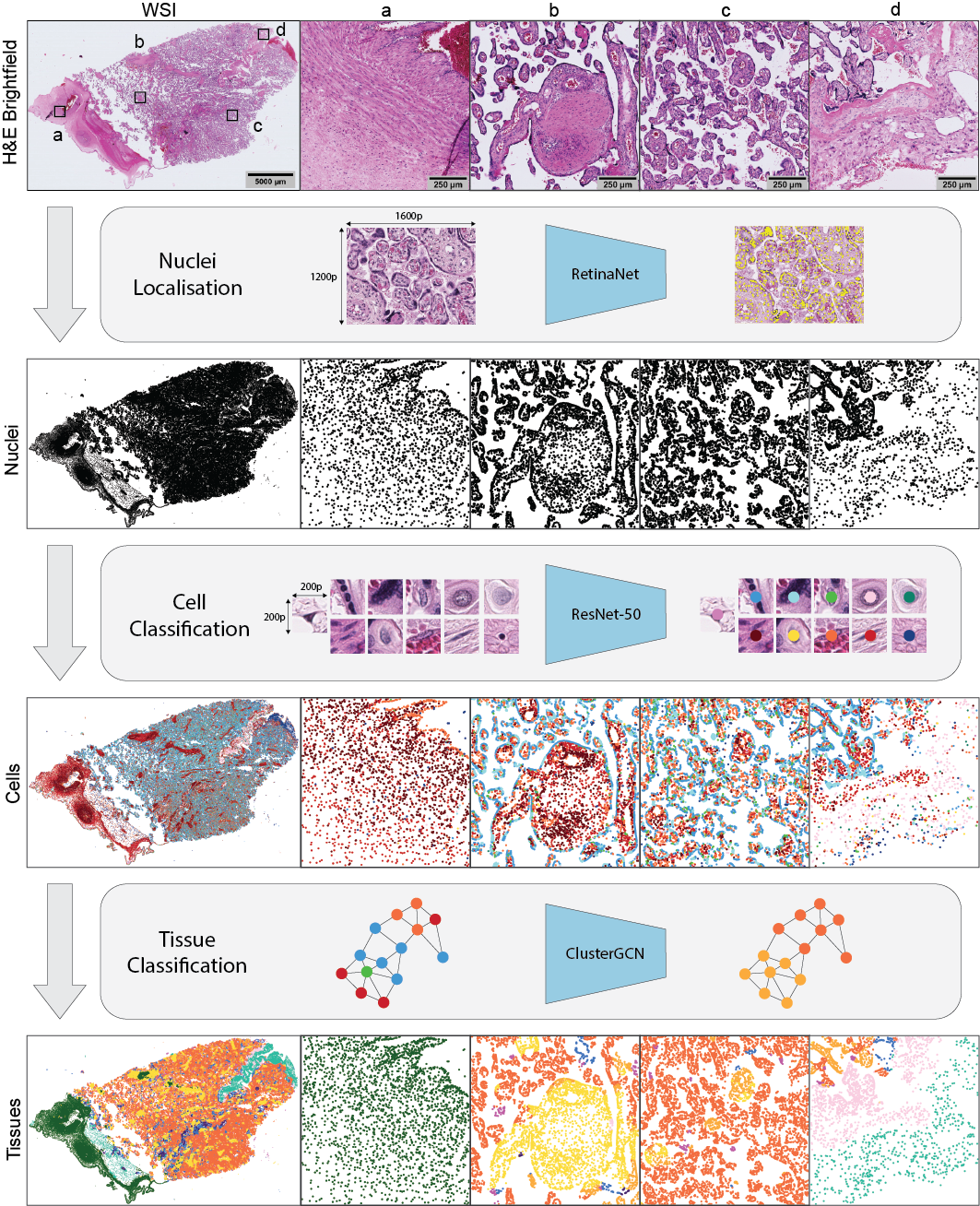
Published pipeline. Vanea et al., Nature Communications, 2024
Locate nuclei across the whole slide image.
Assign detected nuclei to biologically defined placental cell types.
Build a cell graph and classify the tissue around each cell.
Featured research and presentation
HAPPY analyses whole slide histology at three linked levels: nuclei, cell identity and the cell to tissue graph. It produces quantitative measurements of placental composition and spatial structure.
Watch the presentationHAPPY AI to understand the placenta and diseasesResearch question
How can tissue images produce measurements that reflect biology and support clinical research?
I combine computational pathology, representation learning and women’s health.
Selected research
I develop methods, validate their biological meaning and test their relevance to clinical research.
Computational pathology
HAPPY measures the cellular composition and spatial organisation of placental histology. Its biologically inspired pipeline links tissue measurements with pathology and clinical outcomes.
Deep phenotyping
Quantitative analysis of tissue composition across major placental lesion types, producing an organ level view of disease.
Health data science
Methods for analysing rare outcomes in population cohorts using proteomic and clinical data.
How I work
I design models around the organisation of tissue. Their measurements should be biologically coherent, reproducible and useful to researchers and clinicians.
Model how cells are organised within tissue.
Check that the model’s findings reflect real biology.
Build methods that others can reproduce and clinicians can use.
Selected publications
Walker EC, Huang Y, Glastonbury CA, O’Hara K, Fraser A, Gordijn SJ, Ernst LM, Nellaker C
PlacentaWalker EC, Vanea C, Meir K, Hochner-Celnikier D, Hochner H, Laisk T, Lindgren C, Glastonbury CA, Ernst LM, Nellaker C
PlacentaFieggen J, Segal B, Walker EC, Thakur A, Butler CC, Clifton DA, Clifton L
47th IEEE Engineering in Medicine and Biology ConferenceBackground
University of Oxford · Big Data Institute · Jesus College
EPSRC Centre for Doctoral Training in Health Data ScienceUniversity of Michigan School of Public Health
Pseudotime analysis of spatial transcriptomicsUniversity of Exeter · semester abroad at ETH Zürich
Astrocyte inspired neural networks · immunology and tissue repair at ETH ZürichSupervision
Christoffer Nellåker · Hannah Currant · Craig Glastonbury